
One of the first things many new clients do when I visit their home is apologise.
“Sorry, coach, I don’t have any equipment.”
Some clients would ask, “Eh, my friend wants to train also, but landed property no equipment can ah?”
What they’re really asking is:
Can I actually get fit here, at home?
It’s a fair question. When we think about getting in shape, many of us picture rows of treadmills, racks of weights, and dedicated workout spaces. The fitness industry has taught us that we need more before we can begin.
However, after years of training clients in their homes, I’ve come to a different conclusion.
Many people already have enough.
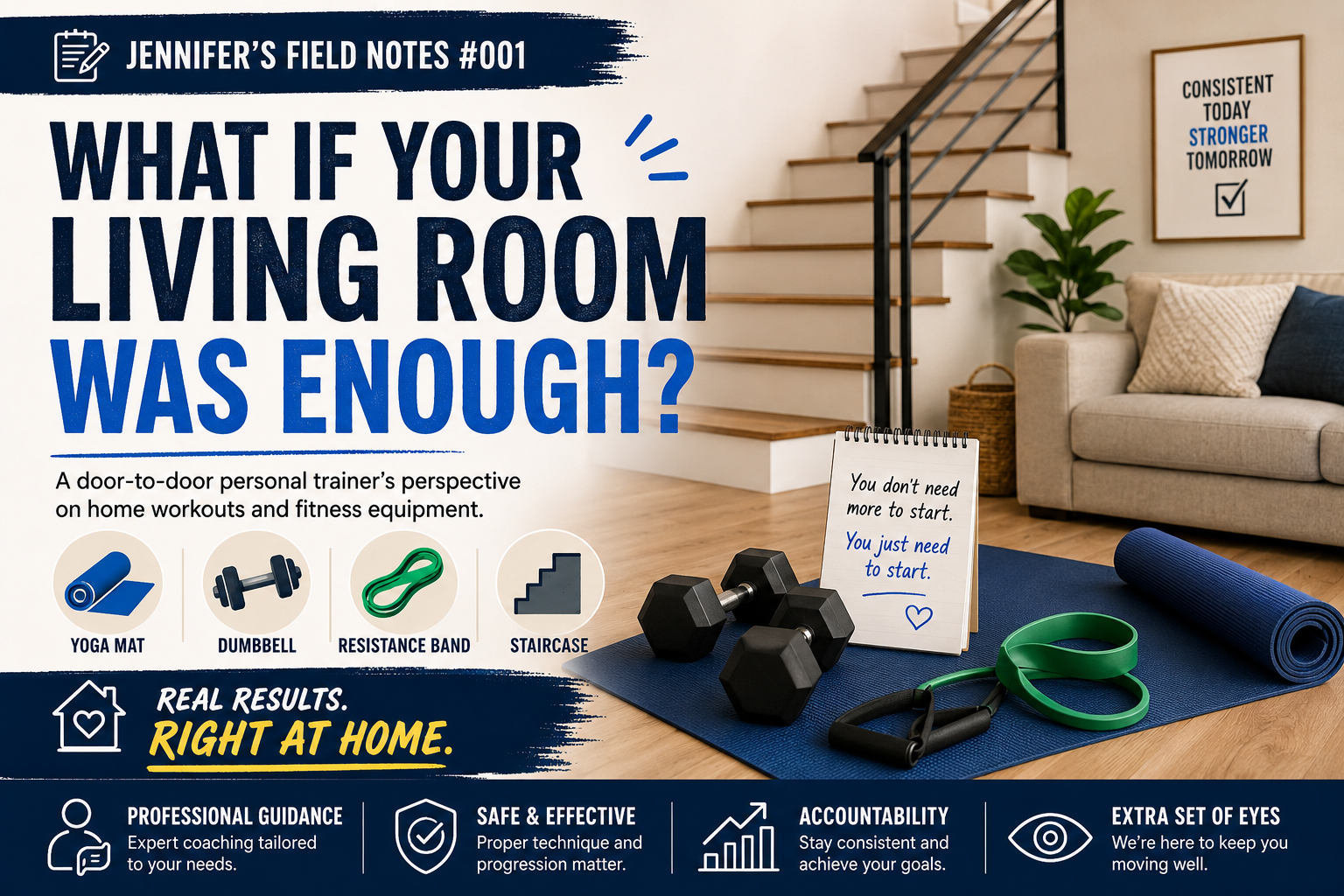
Building a Full Body Strength Workout From 4 Simple Things
Most of my clients’ living rooms are spacious enough. I usually bring a few pieces of equipment that can fit into my car for in-home sessions. Let’s talk about the ones that I use most often:
Yoga Mat: Warm Up & Core Activation
A proper warm-up is crucial for increasing core temperature and heart rate, boosting blood flow to muscles, and helping you mentally prepare to exercise. This is an important step for everyone, especially for beginners, seniors, and people with prior injuries.
I usually start my session with some core work. It’s important to introduce these concepts early on, as it helps:
● Develop awareness of how to engage core muscles
● Improve stability, control, and technique during the exercises that follow
3 core exercises that I like to use:
1. Lying abdominal brace – Focus on diaphragmatic breathing and abdominal bracing
2. Dead bug – Improve core stability and control while moving the limbs
3. Side plank – Increase lateral core stability
Dumbbells: Squats, Bridge & Hamstring Curl (Lower Body Exercise)
Lower-body exercises tend to be more physically demanding because they engage some of the largest muscle groups in the body. These movements often require more energy, coordination, and focus than upper-body exercises. That’s why I usually start with lower-body exercises when energy and focus are at their peak, allowing for better technique and form.
3 lower body exercises that utilise dumbbells are:
1. Goblet squats – Target and strengthen glutes and quads
2. Lying dumbbell hamstring curl – Isolates the hamstrings, which are usually weaker (especially in beginners/ sedentary individuals)
3. Glute bridge – Very beginner-friendly exercise to strengthen glutes and core
Staircase: Incline Push Up (Upper Body Push Exercise)
Remember the last time you had to carry something heavy over your head and find yourself exhausted? (7kgs luggages in the plane’s overhead compartment kind of day?) Having stronger functional muscles like the chest, shoulders, and triceps would make these tasks easier! This is where push-ups come in.
Doing push-ups on the staircase is a great way to start if you can’t perform full push-ups on the floor. The slanted, elevated surface:
● Reduces resistance compared to a full-body weight push-up
● Reduces joint pressure which makes it a safer option
● Allows adjustment of angles to fit your strength level better
As you progress, you can move to lower steps and eventually full-body push-ups!
Resistance Bands: Row (Upper Body Pull Exercise)
Many of my clients came to me with some form of back or neck pain (most commonly, tightness). These concerns usually stem from long hours of sitting and inactivity in general (which most office workers are guilty of). Strengthening the back muscles with pull exercises would greatly help to:
● Manage and prevent back/ neck pain
● Improve posture
● Minimize strain by stabilising the spine
Resistance bands are very versatile tools. By maintaining the same setup and changing just the grips, a seated band row can effectively target most of your back muscles.
● Neutral grip: Lats and mid-back
● Wide grip: Upper back
Your Living Room Is More Than Enough
With some simple equipment and a little bit of creativity, exercising at home can go a long way. However, the challenge is to know how to use it safely and effectively.
Proper exercise selection, technique, and progression become particularly important especially for people with specific physical needs or medical considerations, such as beginners, seniors, children, pregnant women, people recovering from injuries, and those with certain medical conditions. A simple exercise performed with good form can be incredibly effective, while the wrong exercise or poor technique may increase the risk of discomfort or injury.
That’s where having an experienced coach can make all the difference. Beyond bringing equipment, a coach provides structure, guidance, accountability, and most importantly, an extra set of eyes to ensure you’re moving well and progressing safely.
If you’ve been wondering whether home training is right for you, we’d be happy to help.
🌐Contact us at fitnessachievers.com.my
📱 WhatsApp us at +6014-3066316
📧 Email us at fitnessachievers17@gmail.com
Let’s see what we can achieve with the space you already have.